

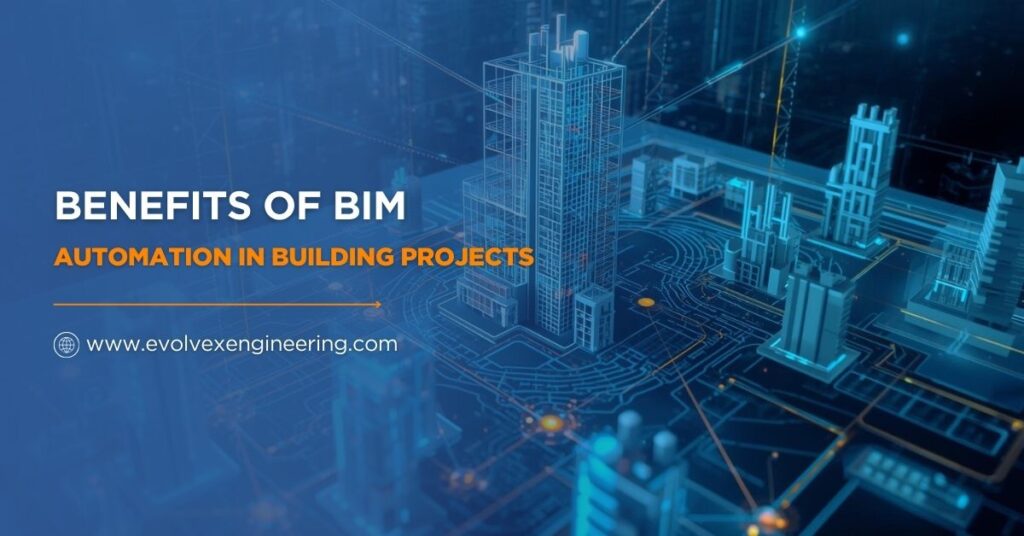
Construction competition is increasing, and project stakeholders are demanding faster delivery, lower costs, and greater precision. To achieve these expectations, many AEC firms are relying on BIM Automation in Building Projects.
This digital shift allows companies to automate their modeling tasks, documentation, clash detection, scheduling, and quantity estimation. It replaces repetitive manual effort with smart rules and scripts, resulting in significant time savings and improved quality.
Today, automation is not just a trend; it is becoming an industry standard. Firms using BIM Automation outperform competitors by delivering more accurate designs, reducing rework, and improving coordination throughout the building lifecycle.
As infrastructure and real estate markets expand globally, automation offers the most effective way to handle increasing project complexities without increasing workforce stress.
What is BIM Automation in Simple Words?
BIM Automation works like a digital assistant for architects, engineers, and contractors. Instead of creating each drawing, calculating quantities, or manually correcting clashes, software tools perform these tasks automatically.
When you make one change in the model, all drawings, schedules, and 3D views update automatically. BIM Automation in Building Projects uses smart scripts, predefined rules, and AI algorithms to accelerate design and documentation, making them faster, more consistent, and nearly error-free.
Leading software such as Revit, Dynamo, Grasshopper, Navisworks, BIM 360, and AI-based plug-ins provide automation features that reduce manual drafting and calculation time by 60%-80%.
In short, automation improves productivity at every stage-from schematic design to construction documentation and project handover.
Firms adopting BIM automation are witnessing accelerated workflows, better building system coordination, and reduced construction risks.
Why BIM Automation Matters Today?
Modern building projects involve multiple disciplines like architecture, MEP, structural engineering, contractors, facility managers, and project owners.
A single mistake in drawings can cause costly site delays and material wastage. BIM Automation in Building Projects has become essential because it eliminates these challenges before construction even begins.
Automating models, schedules, and documentation ensures that every stakeholder receives accurate information instantly, reducing misunderstandings and disputes.
With rising labor costs, tight deadlines, and demand for sustainability, automation saves companies valuable time and reduces operational Workload. It also enables better project tracking, faster approvals, and a smooth handover process backed by accurate digital information. By minimizing risks and improving data accuracy,
BIM automation helps firms maintain higher profitability, greater client trust, and a competitive advantage in the global market.
Top 10 Benefits of BIM Automation in Building Projects
1. Saves Time and Reduces Workload
Time is the biggest asset in construction. Traditional methods require professionals to repeat tasks like drafting floor plans, placing elements, or copying layout designs across building levels.
BIM Automation in Building Projects eliminates repetition by running scripts that automatically replicate design components based on predefined rules. Teams can complete in hours what once required days. Automation also accelerates documentation, scheduling, and annotation workflows.
For Example, an architect who changes a door size no longer needs to revise every plan manually; automation updates all related drawings instantly. This reduces overtime pressure, prevents burnout among professionals, and improves overall productivity.
Companies gain the power to manage more projects with the same workforce and deliver consistently high-quality work.
2. Improves Accuracy and Reduces Human Errors
Manual drafting and documentation are highly vulnerable to errors due to fatigue, oversight, and repetitive Workload.
BIM Automation in Building Projects uses logic-based scripts and rule-driven configurations to maintain consistent model accuracy.
Every building element adheres to predetermined codes and design standards, reducing the risk of dimensional errors, annotation mistakes, and incorrect component placement. Automation also ensures that all drawings and schedules align with the final model, eliminating outdated versions that can confuse the site.
In industries like healthcare, data centers, airports, and industrial buildings-where precision is critical-automation protects companies from costly discrepancies.
Accurate models help contractors execute work more safely, reduce material waste, and avoid rework caused by engineering coordination errors.
3. Faster Clash Detection and Resolution
Clashes are among the biggest reasons for cost escalation in construction. Manually identifying clashes between ducts, beams, pipes, and cables is time-consuming and easy to overlook.
BIM Automation in Building Projects uses software engines that detect clashes instantly and generate reports automatically. Advanced tools even suggest routing corrections based on clearance rules and space optimization.
By resolving conflicts during the design phase rather than the construction phase, companies can reduce material waste, site disputes, and schedule delays. Large projects with complex MEP systems save millions in rework costs through the use of automated clash prevention.
This benefits not only designers but also contractors, subcontractors, and project owners, ensuring a smooth transition from design to on-site installation.
4. Reduces Construction Cost
Accurate planning eliminates uncertainty. With BIM Automation in Building Projects, contractors gain precise quantity takeoffs, material cost forecasts, and better construction sequencing.
Automation supports error-free documentation, which prevents misinterpretation onsite. As a result, project teams avoid ordering excess materials, reducing waste and saving procurement expenses.
Automated design also helps optimize building systems for efficiency, lowering installation and fabrication costs.
In addition, quick clash resolution reduces change orders, a major driver of cost overruns. When construction risk decreases, profit margins increase. For owners, automation provides transparency, ensuring every investment is justified by data-based design decisions.
Ultimately, BIM automation creates a financially sustainable project ecosystem.
5. Quick Generation of Drawings and Reports
Generating a complete set of architectural or MEP drawings used to take weeks. With automation, models now produce detailed plans, elevations, sections, schedules, BOQs, and shop drawings in a fraction of that time.
BIM Automation in Building Projects enables teams to extract all views and sheets from the central model using rules. Whenever changes occur, the model automatically updates information across every drawing.
Automation also standardizes drawing templates, legends, and annotations to maintain uniformity across large projects. This ensures that every stakeholder receives consistent documentation regardless of team size or location.
Combined with automated report generation for clash analysis, quantity extraction, and asset tracking, companies experience unmatched efficiency in design communication.
6. Improves Collaboration Among Teams
Digital collaboration ensures clarity. BIM automation connects architects, engineers, contractors, suppliers, and owners through cloud-based everyday data environments (CDE).
When teams use BIM Automation in Building Projects, every modification automatically synchronizes across all disciplines. This transparency prevents misinformation, duplicate work, and design conflicts.
Meetings become more productive when stakeholders review accurate, real-time models rather than outdated PDFs. Automation also supports multi-user coordination, allowing teams from different regions to work simultaneously on a project.
Integrated workflows reduce approval delays and ensure that all decisions are data-driven. This leads to stronger accountability, faster decision-making, and improved trust across the project lifecycle.
7. Supports Green Building and Sustainability
Sustainability is no longer optional. Automation allows designers to analyze building performance early in the design phase.
Tools integrated with BIM Automation in Building Projects conduct simulations for daylight optimization, carbon footprint reduction, ventilation efficiency, and energy savings. This helps designers choose eco-friendly materials, optimize layouts, and reduce energy consumption.
Automated data-driven insights guide better building orientation, facade design, and HVAC configuration.
Green-certified buildings become easier to achieve, improving asset value for owners. Automated sustainability modeling also reduces guesswork, enabling faster decision-making.
In a world moving towards net-zero construction, BIM automation provides the technical advantage needed to deliver environmentally friendly buildings while maintaining budget discipline.
8. Better Design Quality and Creativity
Automation eliminates repetitive production tasks, allowing designers to invest more time in problem-solving and innovation.
BIM Automation in Building Projects empowers architects to explore parametric forms, space optimization, and advanced layouts without being limited by documentation complexity.
With accurate digital simulations, designers can evaluate multiple design options quickly and select the most effective solution. Automation leads to visually rich presentations, more detailed 3D visualizations, and more transparent client communication.
Structural and MEP engineers benefit from smarter design logic and connection intelligence. Instead of working as drafting operators, professionals evolve into strategic thinkers focused on improving building performance and aesthetics.
9. Strengthens Construction Planning and Scheduling
Planning mistakes can have a significant financial impact. Automation ensures accurate forecasting by linking BIM models with construction schedules (4D) and cost (5D).
With BIM Automation in Building Projects, project managers visualize work sequences, analyze resource requirements, and predict site risks early.
Automated reports show material arrival dates, installation timelines, and workforce planning data. This helps contractors manage onsite activities more effectively. By identifying bottlenecks in advance, automation reduces idle labor, delays, and equipment misuse.
For large-scale infrastructure projects, automated planning boosts execution speed, enabling contractors to deliver on time, every time. Strong planning builds reputation and ensures better financial returns.
10. Improves Client Satisfaction
Ultimately, every project exists to satisfy the client. Automation provides realistic 3D visualizations, accurate information, and predictable outcomes.
With BIM Automation in Building Projects, clients monitor progress transparently, review models interactively, and receive well-organized asset data for future maintenance. This builds long-term confidence.
Automated processes reduce disputes and deliver better quality documents, helping clients avoid unplanned expenses.
Property developers appreciate reduced risk and faster project delivery, while facility managers benefit from accurate digital twins.
Clear communication and precise deliverables strengthen business relationships and create opportunities for repeat business. In a competitive market, satisfied clients become brand ambassadors, helping firms win more projects.